

Who this applies to
Owners of LLCs, partnerships, S-Corps and sole proprietorships with business income on their personal return.
Key questions
- Is your 2026 taxable income above $403,500 (joint) or $201,750 (single), where the limits begin?
- If you own an S-Corp, is your salary helping or hurting your deduction?
- Is your business a specified service business, such as law, health, accounting or consulting?
Review with the OICPA team
- Project your 2026 taxable income before December 31
- Test your S-Corp salary against both the wage limit and payroll tax
- Decide on retirement contributions that could move you below a threshold
The One Big Beautiful Bill Act, signed July 4, 2025, made the 20% QBI deduction permanent; it had been set to expire after 2025. Starting with 2026 returns, the phase-in range is wider and a $400 minimum deduction applies to active owners.
The short answer
The 20% qualified business income (QBI) deduction no longer has an end date. If you own a pass-through business, you can keep deducting up to 20% of its profit on your personal return in 2026 and beyond.
Three things are new for 2026 returns. The income range where the limits phase in is 50% wider. A new $400 minimum deduction applies to active owners with at least $1,000 of QBI. And the 2026 thresholds rose with inflation to $403,500 for joint filers and $201,750 for most others.
What didn't change matters just as much. Above the threshold, your deduction still depends on the W-2 wages your business pays, and for S-Corp owners that includes your own salary. For how the deduction works from year to year, see the QBI deduction explained.
What changed
| Before the 2025 law | 2026 returns onward | |
|---|---|---|
| End date | Expired after 2025 | Permanent |
| Deduction rate | 20% | 20% (the House's 23% proposal was dropped) |
| Phase-in range above the threshold | $100,000 joint, $50,000 others | $150,000 joint, $75,000 others |
| Minimum deduction | None | $400, with at least $1,000 of active QBI |
The changes apply to tax years beginning after December 31, 2025, so your 2025 return still uses the old range.
The wider range helps most if you're just above the threshold. Take a consultant filing jointly with $500,000 of taxable income. Under the 2025 numbers, consulting income above $494,600 got no QBI deduction at all. In 2026 the phase-out runs to $553,500, so the same owner keeps about a third of the deduction.
The 2026 income thresholds
| Filing status | Full 20%, no limits, at or below | Limits phase in between | Fully limited above | 2025: fully limited above |
|---|---|---|---|---|
| Married filing jointly | $403,500 | $403,500–$553,500 | $553,500 | $494,600 |
| Single, head of household | $201,750 | $201,750–$276,750 | $276,750 | $247,300 |
| Married filing separately | $201,775 | $201,775–$276,775 | $276,775 | $247,300 |
The test uses taxable income before the QBI deduction. At or below the threshold, the math is simple: 20% of QBI, capped at 20% of taxable income minus net capital gains.
Above the threshold, two limits apply in part, then in full past the top of the range:
- The wage limit. The deduction can't exceed 50% of the W-2 wages your business pays, or 25% of wages plus 2.5% of the original cost of its equipment and property, whichever is larger.
- The service-business limit. Health, law, accounting, consulting, financial services, performing arts and similar fields lose the deduction entirely above the range. Engineering and architecture are not on that list.
The new $400 minimum
Starting with 2026, if you have at least $1,000 of QBI from businesses you actively run, your QBI deduction is at least $400. Both amounts adjust for inflation after 2026.
To qualify:
- $1,000 or more of QBI, added up across your active businesses.
- Material participation, under the passive activity rules. The common tests: you work in the business more than 500 hours a year, or more than 100 hours and at least as much as anyone else.
- Not passive. Limited partners and silent LLC investors don't qualify, and many rental owners won't either. Neither do service-business owners above the top of the range, because that income no longer counts as QBI.
The regular deduction already reaches $400 once QBI hits $2,000. So the floor mainly helps two groups: side businesses earning $1,000 to $2,000 (a $1,500 profit moves from a $300 deduction to $400), and owners above the range whose wage limit would otherwise zero out the deduction, such as a single-member LLC with no employees.
Keep it in proportion. A $400 deduction saves $48 to $148 of federal tax, depending on your bracket. Claim it, but don't plan around it.
S-Corp salary: Where the deduction is won or lost
If you own an S-Corp, your own salary is not QBI. Every dollar you pay yourself in W-2 wages comes out of the profit the 20% applies to. Partners' guaranteed payments are excluded the same way.
Below the threshold, the answer is simple: a lower salary, as long as it's still reasonable for the work you do, means more QBI, a bigger deduction and less payroll tax. Above the range, salary cuts both ways, because your salary is also the W-2 wages the wage limit is measured against.
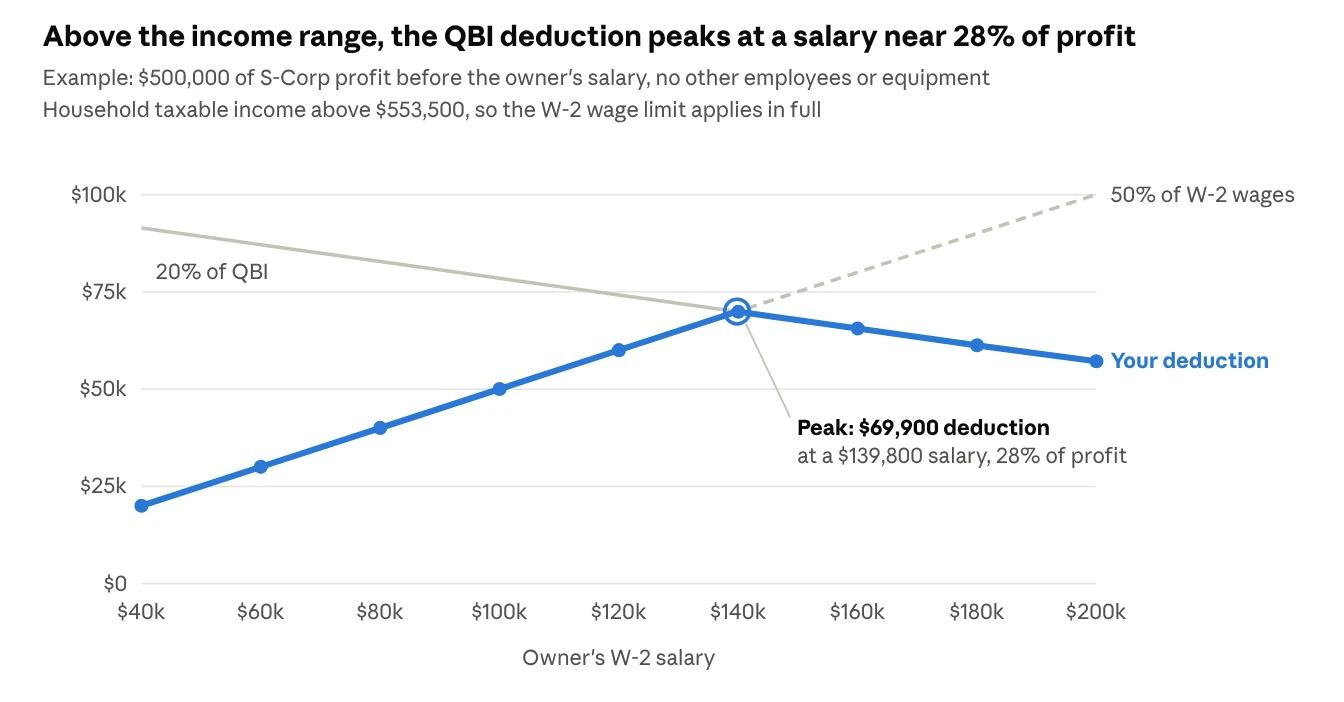
Too little salary and the wage limit caps the deduction; too much and you shrink QBI. Two cautions before you change payroll:
- Reasonable compensation comes first. The IRS expects S-Corp owners to be paid what the job is worth. A salary set only to maximize the deduction won't hold up. See S-Corp reasonable compensation.
- The peak isn't automatically your cheapest salary. Each added dollar of salary costs up to 15.3% in payroll tax, so we compare income tax and payroll tax together. The S-Corp tax savings tool gives a first pass.
Year-end moves that change your 2026 deduction
Most of the levers close on December 31.
- Project your 2026 taxable income now. Where you land against $403,500 joint or $201,750 single decides which rules apply.
- Set final S-Corp payroll. Salary or a year-end bonus counts as 2026 W-2 wages only if it runs through payroll by December 31.
- Use retirement contributions near a threshold. Pre-tax 401(k) deferrals, up to $24,500 for 2026 plus an $8,000 catch-up at 50 or older, lower taxable income. Dropping below the threshold can restore the full, unlimited deduction.
- Model big purchases with QBI. A large bonus depreciation write-off lowers QBI as well as taxable income, so the two should be planned together.
- Check for carried-over QBI losses. A business loss from an earlier year reduces this year's QBI before the 20% is applied.
If you own several businesses, aggregating them can help with the wage limit. The choice is generally permanent, so we model it over several years first.
Frequently asked questions
Is the QBI deduction really permanent now?
Yes, under current law. The One Big Beautiful Bill Act removed the end-of-2025 expiration. Congress can still change it in a future law.
What is the 2026 QBI threshold for married filing jointly?
$403,500 of taxable income, before the QBI deduction. The limits phase in up to $553,500. For single and head of household filers, it's $201,750 to $276,750.
Who gets the new $400 minimum?
Owners with at least $1,000 of QBI from businesses they materially participate in. It applies starting with 2026 returns, and the amounts adjust for inflation after 2026.
Does my S-Corp salary count as QBI?
No. Reasonable compensation paid to you as an S-Corp owner is excluded from QBI. Above the threshold, though, it counts toward the W-2 wage limit, which can raise your deduction.
Do partnership guaranteed payments count?
They are excluded from QBI, and unlike S-Corp salary, they don't count as W-2 wages for the wage limit.
Does New Jersey allow the QBI deduction?
No. The QBI deduction is federal only, so it doesn't reduce New Jersey taxable income.
Not sure your S-Corp salary is helping your QBI deduction?
Before December 31, we run your 2026 numbers both ways. In an S-Corp salary and QBI review, we:
- Project your 2026 taxable income against the $403,500 / $201,750 thresholds
- Test salary levels against the wage limit, payroll tax and reasonable compensation
- Set any year-end payroll, bonus or 401(k) moves while there is still time to run them
References
- One Big Beautiful Bill Act, Part IV: The QBI deduction / Section 199AFoster Garvey, July 17, 2025, updated March 10, 2026
- Rev. Proc. 2025-32 analysis: 2026 QBI thresholds and phase-in rangesCurrent Federal Tax Developments
- How does the QBI deduction affect S corporation shareholders?Blue J
- 401(k) limit increases to $24,500 for 2026 (IR-2025-111)Internal Revenue Service, November 13, 2025
- Social Security taxable wage base for 2026Paycor, citing SSA
- OBBBA tax changes for NJ residentsMonaco CPA, updated October 9, 2026