
Who this applies to
Business owners planning to buy equipment, vehicles or building improvements and put them to work before December 31, 2026.
Key questions
- Will each asset be delivered, installed and ready to use by December 31, not just ordered or paid for?
- Did you sign a binding contract for any of it before January 20, 2025?
- Will your 2026 equipment purchases pass $4,090,000, where Section 179 starts to shrink?
Review with the OICPA team
- List every asset you expect to place in service by December 31, with its delivery and installation dates
- Pull the contract date for any large order signed in 2024 or January 2025
- Model the federal deduction and your state return together before you sign
The One Big Beautiful Bill Act, signed July 4, 2025, made 100% bonus depreciation permanent for property acquired and placed in service after January 19, 2025. Under the old schedule, property placed in service in 2026 would have received 20%.
The short answer
If you acquired an asset after January 19, 2025 and it is in service by December 31, 2026, you can generally deduct 100% of its cost on your 2026 federal return. That covers new and used equipment, software, many work vehicles and interior improvements to commercial buildings. There is no dollar cap, and unlike Section 179, the deduction can create a business loss.
Because the rule is now permanent, there is no tax reason to rush a purchase you don't need. A deduction is not a discount: at a 37% federal rate, a $100,000 machine cuts your tax by up to $37,000, and you still spend $63,000. The only deadline is timing. The asset has to be working this year for the deduction to land on this year's return.
Three details decide whether it does:
- Placed in service, not ordered. Paying in December does nothing if the machine is still crated on January 1.
- Section 179 still has limits. $2,560,000 for 2026, shrinking once purchases pass $4,090,000. It matters for the items bonus depreciation can't reach.
- Old contracts keep old rates. An asset under a binding contract signed before January 20, 2025 gets 20% bonus in 2026, not 100%.
Trap 1: "Placed in service" counts, not "ordered"
Both bonus depreciation and Section 179 start in the year an asset is placed in service. The regulations define that as the date it is first "in a condition or state of readiness and availability for a specifically assigned function." The order date, invoice date and payment date don't matter. Neither does how you pay: a financed asset qualifies the same as one paid in cash.
You don't have to use the asset before year-end. It has to be ready to use.
| Where things stand on December 31 | Counts for 2026? |
|---|---|
| Paid in full, still at the dealer or in transit | No |
| Delivered, but crated or waiting on installation, wiring or permits | No |
| Installed and tested, first job scheduled for January | Yes |
| Truck delivered, titled and available for business use | Yes |
| Build-out finished and the space is ready to open | Yes |
| Build-out 90% done, crew returns January 5 | No |
If a purchase is timed for the deduction, confirm the delivery and installation dates with the vendor in writing. Then keep the proof: the delivery receipt, the installer's sign-off, and a dated photo or log entry showing the asset ready to run. Those three documents answer the question an auditor will ask.
Trap 2: Section 179 stops at $2,560,000 and shrinks past $4,090,000
For 2026, Section 179 lets you expense up to $2,560,000 of qualifying property. The limit drops dollar for dollar once the Section 179 property you place in service during the year passes $4,090,000, and it reaches zero at $6,650,000. Heavy SUVs carry their own $32,000 Section 179 cap.
With 100% bonus available, Section 179 still earns its place for three reasons:
- It reaches property bonus can't. Roofs, HVAC, fire protection and alarm systems, and security systems on a commercial building are usually 39-year property, which bonus doesn't cover. Section 179 can expense them.
- It ignores the January 19, 2025 date. An asset stuck at 20% bonus because of an old contract (Trap 3) can still be expensed under Section 179.
- Some states allow it when they refuse bonus. New Jersey disallows bonus depreciation entirely but allows up to $25,000 of Section 179.
Section 179 also can't exceed your business taxable income. The excess carries forward, and for S-Corps and partnerships the limit applies at both the company and owner level. Bonus depreciation has no income limit.
Crossing the phase-out costs less than it sounds. Place $4,300,000 of property in service and your limit falls by $210,000, to $2,350,000. Bonus still covers the equipment; what you lose is room for the roof, HVAC or security work only Section 179 can expense. If you are close to the line, moving one large delivery into January 2027 resets the count.
Trap 3: Old contracts keep the old rate
The 100% rate applies only to property acquired after January 19, 2025 and placed in service after that date. Under IRS Notice 2026-11, purchased property is acquired on the date you sign a written binding contract, not on delivery or payment.
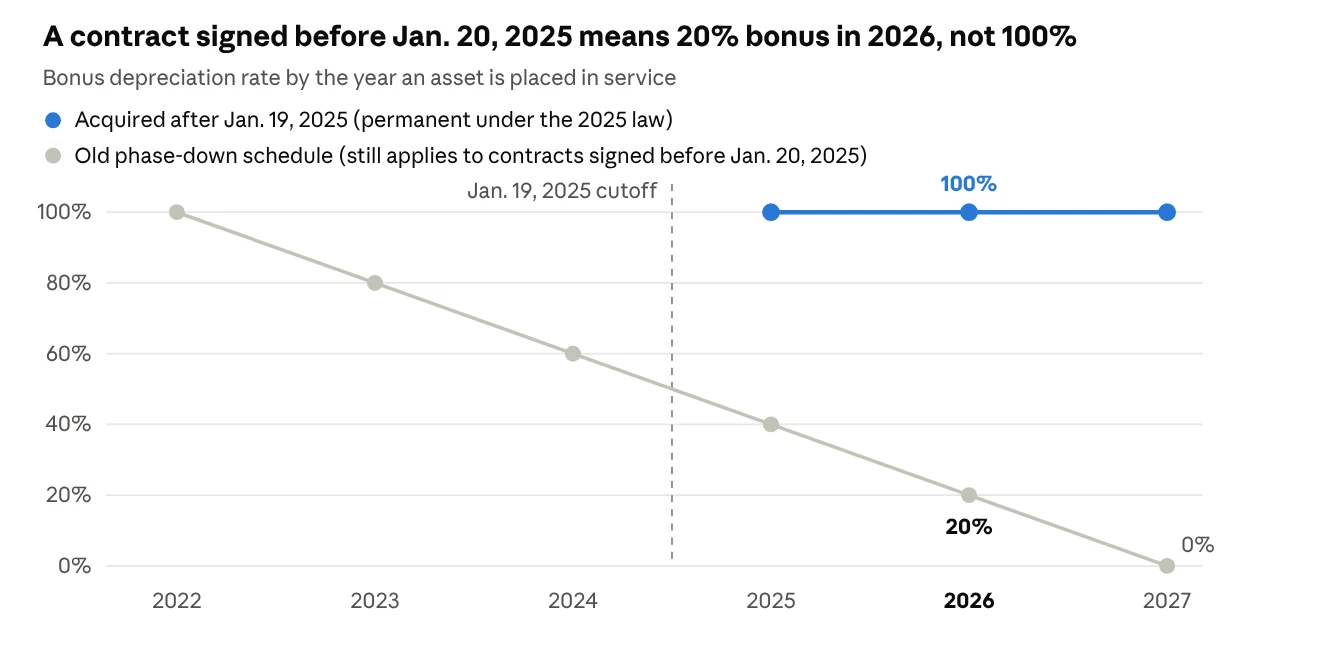
That catches long-lead purchases: custom machinery, trucks or trailers ordered in 2024, or a build-out contract signed before the cutoff. Those assets stay on the old phase-down, which gives 20% bonus if they go into service in 2026 and nothing in 2027.
Three ways to recover the write-off:
- Use Section 179. It has no acquisition-date test, so an old-contract asset can still be expensed, within the $2,560,000 limit and your business income.
- Read the contract. Whether a 2024 deposit agreement or letter of intent was legally binding depends on its terms. Have us review it before you assume the lower rate.
- Split construction projects. For property you build, the date significant physical work began controls. An election can still give 100% to components bought or built after the cutoff, but it must be made on a timely filed return.
What qualifies: Equipment, vehicles and renovations
| Year-end purchase | 100% bonus | Section 179 | Watch for |
|---|---|---|---|
| Machinery, tools, computers, furniture | Yes | Yes | Used items qualify if you haven't used them before and didn't buy them from a related party |
| Off-the-shelf software | Yes | Yes | Custom-built or bundled software may be treated differently |
| Heavy SUV, over 6,000 lb gross vehicle weight | Yes, no SUV cap | Capped at $32,000 | More than 50% business use; the deduction is scaled to your business-use percentage |
| Pickup with a 6-foot-plus bed, cargo van, box truck | Yes | Yes, no SUV cap | More than 50% business use |
| Car or small SUV, 6,000 lb or less | Yes, within the cap | Yes, within the cap | First-year write-off capped at $20,300 with bonus, $12,300 without |
| Interior build-out of a commercial space (qualified improvement property) | Yes, 15-year property | Yes | Excludes enlargements, elevators and escalators, and structural framework; not for residential rentals |
| Roof, HVAC, fire and alarm, security systems on a commercial building | Usually no, 39-year property | Yes | Section 179 is the way to expense these |
| Buying or building a building | Only the shorter-lived parts | No | A cost segregation study moves eligible parts into 5-, 7- and 15-year classes |
Vehicle weights come from the manufacturer's gross vehicle weight rating, usually printed on the driver's door jamb, not the curb weight. Once you claim Section 179 or bonus on a vehicle, you can't switch it to the standard mileage rate later.
Manufacturers have one more option: a separate new 100% write-off for certain factory buildings whose construction begins before 2029. It has its own rules, so ask us before you plan around it.
Before you sign: State tax, recapture and loss limits
The federal write-off is only part of the result. Check four things before the purchase order goes out.
- Your state. New Jersey doesn't allow federal bonus depreciation and caps Section 179 at $25,000, with no carryforward. A machine you write off in full federally is depreciated over its normal life on your New Jersey return. New York State and New York City have also decoupled from the 100% bonus.
- Recapture. Sell the asset early, or let a vehicle's business use drop to 50% or below, and some or all of the deduction comes back as ordinary income.
- The loss limit. Bonus can push your business into a loss, but for 2026 you can use only $256,000 of net business losses ($512,000 on a joint return) against wages, investments and other income. The rest becomes a net operating loss that offsets up to 80% of taxable income in later years.
- Next year's bracket. A deduction is worth more in a 37% year than in a 24% year. If 2026 is a low-income year, you can elect out of bonus for a whole class of assets and spread the deduction into years when it's worth more.
The first-year write-off is an easy number to quote. Your after-tax cost, federal and state, over the years you'll own the asset is the number that should drive the decision.
Frequently asked questions
Is 100% bonus depreciation really permanent?
Under current law, yes. The One Big Beautiful Bill Act removed the phase-down for property acquired after January 19, 2025, and there is no scheduled end date. Congress can still change it in a future law.
I paid a deposit in December and delivery is in January. Which year do I deduct it?
- The deduction follows the date the asset is ready to use, not the date you paid.
Does used equipment qualify for 100% bonus?
Generally yes, if you haven't used that asset before and didn't buy it from a related party, such as a family member or a company you control.
Can I finance the purchase and still deduct 100%?
Yes. The deduction is based on the asset's cost, not the cash you paid this year, so a financed asset placed in service by December 31 qualifies.
Should I use Section 179 or bonus depreciation?
For most equipment the federal result is the same. Section 179 matters for roofs, HVAC and security systems on commercial buildings, for assets under pre-2025 contracts, and for state returns. Our Section 179 vs. bonus depreciation guide covers the trade-offs.
Does New Jersey follow the federal rule?
No. New Jersey disallows bonus depreciation and caps Section 179 at $25,000, so you'll need a separate New Jersey depreciation schedule.
Buying equipment, a vehicle or a build-out before December 31?
Send us the quote or contract before you sign. In a year-end equipment purchase tax review, we:
- Check the acquisition date against January 19, 2025
- Confirm what has to be delivered and installed by December 31
- Model the Section 179 and bonus split against your 2026 income and your New Jersey or New York return
The earlier in December you book, the more room you have to move a delivery date.
References
- Notice 2026-11: Interim guidance on permanent 100% bonus depreciationKPMG, January 14, 2026
- The written binding contract rule's impact on bonus depreciationCohen & Co., February 2026
- Rev. Proc. 2025-32 analysis: 2026 Section 179 limits and excess business loss thresholdsCurrent Federal Tax Developments
- IRS issues higher 2026 depreciation limits for passenger automobiles (Rev. Proc. 2026-15)The Tax Adviser, March 2026
- Bonus depreciation denied for asset used but not considered placed in serviceThe Tax Adviser
- A refresher on the Section 179 deductionWiss
- Gross Income Tax Depreciation Adjustment Worksheet GIT-DEPNJ Division of Taxation
- New Jersey and Pennsylvania budget updatePKF O'Connor Davies, August 12, 2026
- Modification and extension of limitation on excess business lossesCitrin Cooperman, October 15, 2026